

Professor Xiaowen Shi from Wuhan University
Organisms use ion-conducting signals to perform various functions, including interactions with the environment through sensory, nerve, and muscular systems. Biological communication can control the flow of ions through the difference in ion concentration inside and outside the biological membrane, and instantaneously open the transmembrane channel to allow ions to pass. Emerging biological research shows that redox mode is also particularly important for the interaction between organisms and their environment, which provides a unique way for biological communication. Organisms use different mechanisms to control the flow of charge carriers: the flow of soluble ions is controlled using structural barriers (such as membranes) and gates (such as transmembrane protein channels), while the flow of insoluble electrons uses redox reactions. Controlled by the network (Figure 1).
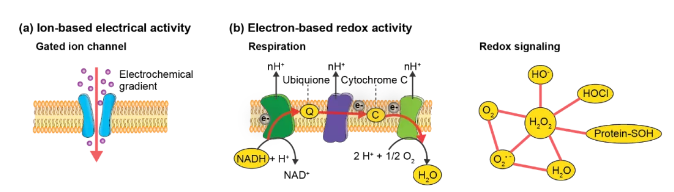
Figure 1. (a) Ion channels involve the transport of soluble ions across membranes. (b) Electron-based redox activity involves the flow of insoluble electrons and forms a network structure through redox reactions. In order to simulate the electron flow in the redox mode of living organisms, the author adopted a simple electrochemical method to pattern catechol onto chitosan/agarose polysaccharide hydrogel, through the catechol node The flow of electrons changes the redox state of the hydrogel. The redox state of the node can be detected by passively observing its optical absorbance or active electrochemical methods (ie "reading"). And found that the patterned catechol region can be used as a node of electron flow mediated by redox reaction (Figure 2). In addition, the catechol node can be switched through a biological mechanism, which enables the prepared catechol node to be embedded in the biochemical redox reaction network to promote biological electronic communication. Therefore, patterned hydrogels with redox activity can be used as an important molecular circuit component in the field of miniaturized, deployable and sustainable redox bioelectronics.

The related results are titled "Hydrogel Patterning with Catechol Enables Networked Electron Flow" and published in the internationally renowned journal Advanced Functional Materials. The first author of the paper is Wu Si, Ph.D. from Wuhan University, and the corresponding authors are Professor Shi Xiaowen of Wuhan University and Professor Gregory F. Payne of the University of Maryland in Parker. DOI: 10.1002/adfm.202007709
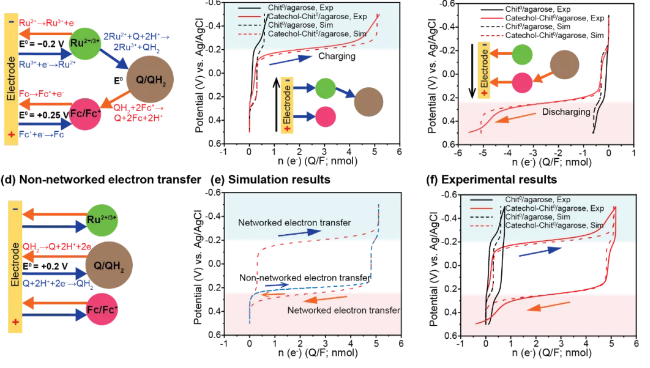
Figure 2. Simulations and experiments demonstrate the flow of meshed electrons. (A, b, c) The hydrogel modified with catechol can form a network of electron flow with redox media. (D, e, f) Non-reticulated electron flow model.
Information source: scientific research
This information is from the Internet for academic exchanges. If there is any infringement, please contact us and delete it immediately
Figure 1. (a) Ion channels involve the transport of soluble ions across membranes. (b) Electron-based redox activity involves the flow of insoluble electrons and forms a network structure through redox reactions. In order to simulate the electron flow in the redox mode of living organisms, the author adopted a simple electrochemical method to pattern catechol onto chitosan/agarose polysaccharide hydrogel, through the catechol node The flow of electrons changes the redox state of the hydrogel. The redox state of the node can be detected by passively observing its optical absorbance or active electrochemical methods (ie "reading"). And found that the patterned catechol region can be used as a node of electron flow mediated by redox reaction (Figure 2). In addition, the catechol node can be switched through a biological mechanism, which enables the prepared catechol node to be embedded in the biochemical redox reaction network to promote biological electronic communication. Therefore, patterned hydrogels with redox activity can be used as an important molecular circuit component in the field of miniaturized, deployable and sustainable redox bioelectronics.
The related results are titled "Hydrogel Patterning with Catechol Enables Networked Electron Flow" and published in the internationally renowned journal Advanced Functional Materials. The first author of the paper is Wu Si, Ph.D. from Wuhan University, and the corresponding authors are Professor Shi Xiaowen of Wuhan University and Professor Gregory F. Payne of the University of Maryland in Parker. DOI: 10.1002/adfm.202007709
Figure 2. Simulations and experiments demonstrate the flow of meshed electrons. (A, b, c) The hydrogel modified with catechol can form a network of electron flow with redox media. (D, e, f) Non-reticulated electron flow model.
Information source: scientific research
This information is from the Internet for academic exchanges. If there is any infringement, please contact us and delete it immediately
18915694570
Previous: Review of Mater. Horiz